
View All Hunger Report Endnotes
Chapter 1: Livelihoods
View chapter 1 in a printer-friendly format.
-
- Relief Web (July 2, 2017), “Agriculture ministers urged to address African youth unemployment.”
- United Nations Department of Economic and Social Affairs: Disability Fact Sheet.
- Alice Albright (April 15, 2014), “Disabled People in Developing Countries Are the Poorest of the Poor,” Global Partnership for Education.
- International Labor Organization (2017), World Social Protection Report.
- International Labor Organization (2017), World …Social Protection Report 2017-2019.
- World Bank (2015), Ending Hunger and Poverty by…2030: An Agenda for the Global Food System.
- African Development Bank (2018), Jobs for Youth in Africa: Improve the quality of life for people in Africa.
- The World Bank: World Development Indicators: School Enrollment, Secondary (%gross).
- Roger Thurow (2016), The First 1,000 Days: A Crucial Time for Mothers and Children—and the World.
- Felix Kwame Yeboah (March 2018), Youth for Growth: Transforming Economies through Agriculture, Chicago Council on Global Affairs.
- Alice Albright (April 15, 2014), “Disabled People in Developing Countries Are the Poorest of the Poor,” Global Partnership for Education.
- Joy Diaz (March 16, 2016), “Meet a Tractor That Can Plow Fields and Talk to the Cloud,” NPR.
- Kimberly Ann Elliott (June 26, 2017), Global Agriculture and the American Farmer, Center for Global Development.
- The World Bank: World Bank Assistance for Trade in Africa.
- The World Bank: Manufacturing Value Added (% of GDP).
- Vivien Foster and Cecilia Briceno-Garmendia (2010), Africa’s Infrastructure: A time for Transformation, The World Bank.
- Teresa Tritch (March 7, 2014), “F.D.R. Makes the Case for the Minimum Wage,” The New York Times.
- Federal Communications Commission (January 29, 2016), 2016 Broadband Progress Report.
- Joel Achenbach and Dan Keating (April 10, 2016), “A new divide in American death,” The Washington Post.
- Economic Research Service, U.S. Department of Agriculture.
- United States Department of Labor, Bureau of Labor Statistics: Labor Force Statistics from the Current Population Survey.
- United States Department of Agriculture, Food and Nutrition Service: Supplemental Nutrition Assistance Program Participation and Costs.
- Brynne Keith-Jennings and Vincent Palacios (May 10, 2017), SNAP Helps Millions of Low-Wage Workers, Center on Budget and Policy Priorities.
- David Cooper (June 15, 2018), On in nine U.S. workers are paid wages that can leave them in poverty, even when working full time, Economic Policy Institute.
- David Cooper and Teresa Kroeger (May 10, 2017), Employers steal billions from workers’ paychecks each year, Economic Policy Institute.
- Elise Gould (March 1, 2018), The State of American Wages 2017, Economic Policy Institute.
- Lawrence Mishel and Jessica Schieder (August 16, 2018), CEO Compensation Surged in 2017, Economic Policy Institute.
- Gene Sperling (2007), “Rising Tide Economics,” Democracy.
- Ambar Narayan et al. (2018), Fair Progress? Economic Mobility across Generations around the World, The World Bank Group.
- Dylan Matthews (March 21, 2018), “The massive new study on race and economic mobility in America, explained,” Vox.
- Raj Chetty et al. (2017), “The Fading American Dream: Trends in Absolute Income Mobility Since 1940,” Science 356 (6336): 398-406.
- National Low-Income Housing Coalition, Out of Reach 2017.
- Elise Gould (March 1, 2018), The State of American Wages 2017, Economic Policy Institute.
- Democracy Now! (April 13, 2018), Nearly 4 People Are Evicted Every Minute: New Project Tracks U.S. Eviction Epidemic & Effects.
- Ben Zipper (June 13, 2018), The erosion of the federal minimum wage has increased poverty, especially for black and Hispanic families,” Economic Policy Institute.
- Ben Zipper (June 13, 2018), The erosion of the federal minimum wage has increased poverty, especially for black and Hispanic families,” Economic Policy Institute.
- United States Department of Labor, Bureau of Labor statistics (March 2018), Characteristics of minimum wage workers, 2017.
- David Cooper (April 2017), Raising the minimum wage to $15 by 2024 would lift wages for 41 million American workers, Economic Policy Institute.
- National Conference of State Legislatures: State Minimum Wages.
- National Low-Income Housing Coalition, Out of Reach 2017.
- Jordan Weissman (October 23, 2013), “Audio: McDonald’s Tells Its Employees to Sign Up for Food Stamps,” The Atlantic.
- Karen Weise (October 2, 2018), “Amazon to Raise Minimum Wage to $15 for all U.S. Workers,” The New York Times.
- Arloc Sherman (September 12, 2018) Census: Programs Eyed for Cuts keep Millions from Poverty, Center on Budget and Policy Priorities.
- Chuck Marr (August 1, 2014), Reagan’s Actions Made Him a True EITC Champion, Center on Budget and Policy Priorities.
- Chuck Marr et al. (October 1, 2015), EITC and Child Tax Credit Promote Work, Reduce Poverty, And Support Children’s Development, Research Finds, Center on Budget and Policy Priorities.
- Dylan Bellisle and David Marzahi (2015), Restructuring the EITC: A Credit for the Modern Worker, Center for Economic Progress.
- Robert Greenstein (February 20, 2013), Minimum Wage Proposal and Essential Step to Making Work Pay, Center on Budget and Policy Priorities.
Chapter 2: Nutrition
View chapter 2 in a printer-friendly format.
-
- Jim Yong Kim (December 6, 2017), 27th Annual Martin J. Foreman Memorial Lecture, delivered at the International Food Policy Research Institute.
- Mark Tran (June 5, 2013), “Malnutrition identified as root cause of 3.1 million deaths among children,” The Guardian.
- Huizhong Wu (March 20, 2018), “Anemia doubles risk of deaths for pregnant women, study finds,” CNN.
- Global Panel on Agriculture and Food Systems for Nutrition (2017), Healthy diets for all: A key to meeting the SDGs.
- Black, RE et al. (2008), Maternal and child undernutrition: global and regional exposures and health consequences. The Lancet.
- World Health Organization. Nutrition—Joint Child Malnutrition Estimates 2019 Edition.
- https://data.unicef.org/topic/nutrition/malnutrition/
- World Health Organization. Nutrition—Joint Child Malnutrition Estimates 2019 Edition.
- OECD/DAC, Statistical Annex of the 2007 Development Co-operation Report, December 2007. See Table 18.
- Save the Children UK (2012), A Life Free From Hunger: Tackling Child Malnutrition.
- USAID (2018), A Decade of Progress: Feed the Future Snapshot.
- Corinna Hawkes, Jody Harris, and Stuart Gillespie (2017), “Changing Diets: Urbanization and the Nutrition Transition,” Chapter 4 of Global Food Policy Report, International Food Policy Research Institute.
- Ibid.
- World Health Organization. Nutrition—Joint Child Malnutrition Estimates 2019 Edition.
- Collins et al. (2006), Management of severe acute malnutrition in children. The Lancet: 1992-2000.
- Ibid.
- Bhutta, Z. et al. (2013), Evidence-based interventions for improvement of maternal and child nutrition: what can be done and at what cost? The Lancet Nutrition Interventions Review Group and the Maternal and Child Nutrition Study Group.
- Dr. Gareth Jones et al. (2003), “How Many Child Deaths Can We Prevent This Year?” The Lancet 362. Volume 362, Issue 9377.
- World Health Organization (February 7, 2018), Fact Sheet: Drinking-water.
- Meera Shekar et al. (2017), An Investment Framework for Nutrition: Reaching the Global Targets for Stunting, Anemia, Breastfeeding, and Wasting. World Bank Group.
- Boone and Johnson (2008), “Breaking Out of the Pocket: Do Health Interventions Work? Which and in What Sense?” in Easterly, What Works in Development? Thinking Big and Thinking Small, Brookings Institution.
- Ibid.
- Ibid.
- Gretchen A Stevens et. al. (2013), “Global, regional, and national trends in hemoglobin concentration and prevalence of total and severe anemia in children and pregnant and non-pregnant women for 1995-2011: a systematic analysis of population-representative data,” The Lancet Global Health, Volume 1, Issue 1 e16-e25. 2013.
- Ibid.
- JP Pena-Rosa et. al. (2015). Daily oral iron supplementation during pregnancy.Cochrane Database of Systematic Reviews 12: CD004736.
- Food and Agriculture Organization of the United Nations (February 2012), Rural Women and the Millennium Development Goals.
- World Bank (2003), Gender Equality and the Millennium Development Goals.
- Jann Lay and Anne-Sophie Robilliard (2009), The Complementarity of MDG Achievements: The Case of Child Mortality in Sub Saharan Africa, Policy Research Working Paper Series 5062, World Bank.
- The World Bank: Prevalence of stunting, height for age (percentage of children under 5).
- Kathryn J. Edin and H. Luke Shaefer (2015), $2.00 Per Day: Living on Almost Nothing in America, Houghton Mifflin.
- Michelle Samuels Boston University School of Public Health (January 5, 2017), ‘It’s Hard to Say Whether It’s Better or Worse,” A Conversation with David Jones, Assistant Professor, Health Law, Policy and Management.
- Ellen B. Meacham (2018), Delta Epiphany: Robert F. Kennedy in Mississippi, University Press of Mississippi.
- Hilary W. Hoynes, Diane Whitmore Schanzenbach, and Douglas Almond (November 2012), Long-run Impacts of Childhood Access to the Safety Net, National Bureau of Economic Research, NBER Working Paper No. 18535.
- Danilo Trisi (September 14, 2018), Economic Security Programs Cut Poverty Nearly in Half Over Last 50 years, New Data Show, Center on Budget and Policy Priorities.
- Federal Reserve Bank of St. Louis: Gross Domestic Product.
- Alicia Coleman-Jensen et al. (2018), Household Food Security in the United States in 2017, United States Department of Agriculture, Economic Research Service.
- Karen Cunnyngham (July 2018), Trends in Supplemental Nutrition Assistance Program Participation: Fiscal Year 2010 to Fiscal Year 2016, United States Department of Agriculture, Food and Nutrition Service.
- Center on Budget and Policy Priorities: Chart Book: SNAP Helps Struggling Families Put Food on the Table.
- Center on Budget and Policy Priorities: Policy Basics; The Supplemental Nutrition Assistance Program.
- Bread for the World Institute. 2008 Hunger Report: Working Harder for Working Families.
- Feeding America website: Why should you support Feeding America?
- Nancy S. Weinfeld et al. (August 2014), Hunger in America 2014: A national report prepared for Feeding America, Westat and Urban Institute.
- United States Department of Agriculture and United States Department of Health and Humn Services (February 2015), Scientific Report of the 2015 Dietary Guidelines Advisory Committee, Part D. Chapter 3: Individual Diet and Physical Activity Behavior Change, p. 2.
- RTI International (July 2014), Current and Prospective Scope of Hunger and Food Security in America: A Review of Current Research.
- Joyce A. Martin et al. (January 31, 2018), “Births: Final Data for 2016,” National Vital Statistics Reports, Volume 64, Number 1, National Vital Statistics Reports, vol. 67, No. 1.
- The World Bank: Low-birthweight babies (%of births).
- RTI International (July 2014), Current and Prospective Scope of Hunger and Food Security in America: A Review of Current Research.
- Ibid.
- Alexia Fernandez Campbell (October 18, 2018), “Social Security, food stamps, and other programs kept 44 million people out of poverty last year,” Vox.
- Seth A Berkowitz, Hilary K Seligman, and Niteesh K. Choudhry (2014), “Treat or Eat: Food Insecurity, Cost-related Medication Underuse, and Unmet Needs,” The American Journal of Medicine, Vol. 127, No. 4. .
- Robert Wood Johnson Foundation (December 2011), Health Care’s Blind Side: The Overlooked Connection Between Social Needs and Good Health.
- Randy Oostra (2014), A Case to End U.S. Hunger Using Collaboration to Improve Population Health, ProMedica.
- Centers for Disease Control and Prevention: Social Determinants of Health: Frequently Asked Questions.
- Colorado Blueprint to End Hunger (January 19, 2018), “Seize the Opportunity: Colorado Blueprint to End Hunger.”
- Bread for the World Institute, 2016 Hunger Report: The Nourishing Effect: Ending Hunger, Improving Health, Reducing Inequality.
- Center on Budget and Policy Priorities: “Low-Income Children Participating in WIC Have Vaccination Rates Comparable to Higher-Income Children.”
- Marianne P. Bitler and Janet Currie (2005), “Does WIC Work? The Effect of WIC on Pregnancy and Birth Outcomes,” Journal of Policy Analysis and Management, Volume 24, Issue 1, pp. 73-91.
- Douglas Almond, Hilary W. Hoynes, and Diane Whitmore Schanzenbach (May 2011), “Inside the War on Poverty: The Impact of Food Stamps on Birth Outcomes,” The Review of Economics and Statistics, 93(2), pp. 387-403.
- Julie A Caswell and Ann L Yaktine, eds. (2013), Supplemental Nutrition Assistance Program: Examining the Evidence to Define Benefit Adequacy, Institute of Medicine, National Academies Press.
- Ann M. Collins et al. (May 2016), Summer Electronic Benefits Transfer for Children (SEBTC) Demonstration: Summary Report, Abt Associates and Mathematic Policy Research, submitted to U.S. Department of Agriculture, Food and Nutrition Service.
Chapter 3: Gender
View chapter 3 in a printer-friendly format.
-
- Malala Yousafzai (July 12, 2013), address to United Nations Youth Assembly.
- Grow Africa (2016), Smallholder Working Group Briefing Paper—Women Smallholders.
- Landesa (February 22, 2016), “The Law of the Land: Women’s Rights to Land.”
- United States Agency for International Development: Land Links (December 1, 2016), Fact Sheet: Land Tenure and Women’s Empowerment.
- Black, RE et al. (2008), Maternal and child undernutrition global and regional exposures and health consequences. The Lancet.
- Lisa C. Smith and Lawrence Haddad (1999), Explaining Child Malnutrition in Developing Countries: A Cross-Country Analysis International Food Policy Research Institute.
- UNICEF (May 4, 2011), “UNICEF says education for women and girls a lifeline to development.”
- Sonali Jain-Chandra et. al. (May 2018), Gender Equality: Which Policies Have the Biggest Bang for the Buck? International Monetary Fund.
- McKinsey Global Institute (September 2015), The Power of Parity: How Advancing Women’s Equality Can Add $12 Trillion to Global Growth.
- United States Department of Agriculture, Foreign Agricultural Service: Active McGovern-Dole Projects.
- United States Department of Agriculture Foreign Agricultural Service: The Global Effort to Reduce Child Hunger and Increase School Attendance, McGovern-Dole Food for Education and Child Nutrition Program, Report to the United States Congress, Fiscal Year 2015.
- United States Department of Agriculture Foreign Agricultural Service: The Global Effort to Reduce Child Hunger and Increase School Attendance, McGovern-Dole Food for Education and Child Nutrition Program, Report to the United States Congress, Fiscal Year 2015.
- UNESCO (2018), Global Education Monitoring Report Gender Review: Meeting our commitments to gender equality in education.
- UNESCO (2018), Global Education Monitoring Report Gender Review: Meeting our commitments to gender equality in education.
- Global Partnership for Education (September 24, 2018), 12 years to break down barriers to girls’ education.
- UN Women: Fast Facts: statistics on violence against women and girls.
- Girls Not Brides: Child Marriage Information Sheet.
- Quentin Woodon et al. (2017), The Economic Impacts of Child Marriage: Global Synthesis Report, The World Bank Group.
- UNESCO (2018), Global Education Monitoring Report Gender Review: Meeting our commitments to gender equality in education.
- Global Partnership for Education: Education costs per child.
- UNESCO (June 2017), Reducing global poverty through universal primary and secondary education, Policy Paper 32/Fact Sheet 44.
- Global Partnership for Education (July 11, 2018), Missed Opportunities: The High Cost of Not Educating Girls.
- U.S. Government (2016), The United States Global Strategy to Empower Adolescent Girls.
- Onize Ohikere (March 29, 2018), “A Smile in the Sorrow,” World Magazine.
- Onize Ohikere (March 29, 2018), “A Smile in the Sorrow,” World Magazine.
- Shirley Chisholm (1970), Unbought and Unbossed, Houghton Mifflin.
- Ariane Hegewisch and Emma Williams-Baron (April 9, 2018), The Gender Wage Gap by Occupation 2017 and by Race and Ethnicity, Institute for Women’s Policy Research.
- Elise Gould and Jessica Schieder (April 6, 2018), Equal Pay Day is a reminder that you can’t mansplain away the gender pay gap, Economic Policy Institute.
- Kevin Miller et al. (2018), The Simple Truth About the Gender Wage Gap, American Association of University Women.
- Kevin Miller et al. (2018), The Simple Truth About the Gender Wage Gap, American Association of University Women.
- Kevin Miller et al. (2018), The Simple Truth About the Gender Wage Gap, American Association of University Women.
- National Partnership for Women & Families (September 2018), America’s Women and the Wage GAP.
- Tom Ostapchuk (February 19, 2016), Breakdown of US High School Graduation Rates. Huffington Post.
- National Women’s Law Center (May 2017), Equal Pay for Mothers Is Critical for Families.
- National Women’s Law Center (May 2017), Equal Pay for Mothers Is Critical for Families.
- Jessica May et al. (April 5, 2017), The Impact of Equal Pay on Poverty and the Economy, Institute for Women’s Policy Research.
- Meika Berlan and Morgan Harwood (September 2018), National Snapshot: Poverty Among Women & Families, 2018, National Women’s Law Center.
- Meika Berlan and Morgan Harwood (September 2018), National Snapshot: Poverty Among Women & Families, 2018, National Women’s Law Center.
- Jessica May et al. (April 5, 2017), The Impact of Equal Pay on Poverty and the Economy, Institute for Women’s Policy Research.
- Stephen Campbell (September 6, 2017), U.S. Home Care Workers: Key Facts (2017), PHI.
- Restaurant Opportunities Centers United (2012), Tipped Over the Edge: Gender Inequity in the Restaurant Industry.
- Rutgers University: Center for American Women in Politics.
- Rutgers University: Center for American Women in Politics.
- Rutgers University: Center for American Women in Politics: Facts on Women in Politics.
- Claire Cain Miller (November 10, 2016), “Women Actually Do Govern Differently,” The New York Times.
- Heidi Hartmann (March 28, 2018), The Economic Status of Women in the U.S.: What Has Changed in the Last 20-40 Years, Institute for Women’s Policy Research.
- Sarah Kliff (March 8, 2017), “The research is clear: electing more women changes how government works,” Vox.
- Erin Loos Cutraro, “Get 250k Women to Run by 2030: Why Equal Representation in Government Matters,” LushUSA
- Jennifer L. Lawless and Richard L. Fox (May 2008), “Why Are Women Still Not Running for Public Office?” Issues in Governance Studies, Brookings Institution.
- Mary Ann Georgantopoulos (May 10, 2018), “Thai Candidate Became the First Woman to Use Campaign Funds to Pay for a babysitter,” BuzzFeed.
- Linda Kramer Jenning (July 31, 2018), “Women of Color Face Significant Barriers When Running for Office. But They’re Finding Support.” Yes Magazine.
- Rutgers University: Center for American Women in Politics
- Rutgers University: Center for American Women in Politics
Chapter 4: Climate
View chapter 4 in a printer-friendly format.
-
- USAID (2012), Building Resilience to Recurrent Crises.
- Food Security Information Network (2018), Global Report on Food Crises 2018
- FAO, IFAD, UNICEF, WHO, and WFP (2018), The State of Food Security and Nutrition in the World 2018: Building Climate Resilience for Food Security and Nutrition.
- Matthew R. Smith and Samuel S. Myers (September 2018), “Impact of anthropogenic CO2 emissions on global human nutrition,” Nature Climate Change, Vol. 8, 834-839.
- Simon J. Lloyd, R. Sari Kovats, and Zaid Chalabi (2011), “Climate, Crop Yields, and Undernutrition: Development of a Model to Quantify the Impact of Climate Scenarios on Child Undernutrition,” Environmental Health Perspectives 119(12).
- Lauren Markham (June 29, 2018), “A Warming World Creates Desperate People,” The New York Times.
- FAO, IFAD, UNICEF, WHO, and WFP (2018), The State of Food Security and Nutrition in the World 2018: Building Climate Resilience for Food Security and Nutrition.
- FAO, IFAD, UNICEF, WHO, and WFP (2018), The State of Food Security and Nutrition in the World 2018: Building Climate Resilience for Food Security and Nutrition.
- Food Security Information Network (2018), Global Report on Food Crises 2018
- Stephane Halegatte et al. (January 2016), Shock Waves: Managing the Impacts of Climate Change and Poverty, World Bank Group.
- United Nations (2010), The Right to Water, Fact Sheet No. 35.
- World Bank Group (2016), High and Dry: Climate Change, Water, and the Economy.
- Matthias Garshagen et al. (November 2015), World Risk Report 2015, Alliance Development Works and United Nations University – Institute for Environment and Human Security.
- Francesca de Chatel (2014), “The Role of Drought and Climate Change in the Syrian Uprising: Untangling the Triggers of the Revolution,” Middle Eastern Studies Vol. 50, No. 4.
- NASA: Global Climate Change: Vital Signs for the Planet: How Climate Is Changing.
- The Green Climate Fund: GCF in Brief: The Replenishment Process.
- America’s Pledge (2018), Fulfilling America’s Pledge: How States, Cities, and Businesses are leading the United States to a Low-Carbon Future. Bloomberg Philanthropies.
- RE100.
- Tess Riley (July 10, 2017), “Just 100 companies responsible for 71% of global emissions, study says,” The Guardian.
- The CGIAR Fund: Securing Investments for a Food Secure Future.
- FAO, IFAD, UNICEF, WHO, and WFP (2018), The State of Food Security and Nutrition in the World 2018: Building Climate Resilience for Food Security and Nutrition.
- Global Compact for Migration: Global Compact For Safe, Orderly and Regular Migration.
- Global Compact for Migration: Global Compact For Safe, Orderly and Regular Migration.
- Danielle Baussan (August 18, 2015), When You Can’t Go Home: The Gulf Coast 10 Years After Katrina, Center for American Progress.
- Alan Duke (October 31, 2012), “Superstorm Sandy Breaks records,” CNN.
- CNN: Hurricane Sandy Fast Facts.
- Eleanor Ainge Roy (February 21, 2018), “Stronger Storms mean new ‘category six’ scale may be needed,” The Guardian.
- Oliver Milman (September 13, 2018), “Climate change means hurricane Florence will dump 50% more rain,” The Guardian.
- The Data Center: Lower Ninth Ward Statistical Area.
- Jeremy Deaton (September 1, 2017), “Hurricane Harvey hit low-income communities hardest,” Think Progress.
- National Oceanic and Atmospheric Service: “Why percentage of the American population lives near the coast?”
- Lauren Zanolli (March 15, 2016), “Louisiana’s vanishing island: the climate ‘refugees’ resettling for $52m,” The Guardian.
- Leah Platt Boustan et al. (July 2, 2017), “Natural Disasters by Location: Rich Leave and Poor Get Poorer,” Scientific American.
- Center for Puerto Rican Studies (2018), Puerto Rico Post Maria.
- Henry J. Kaiser Family Foundation (September 26, 2016), “8 Questions & Answers about Puerto Rico.”
- Cora Russell (May 1, 2016), “Are You Ready? Do You Know How USDA’s Nutrition Assistance Programs can Play a Vital Role in Helping Those Most in Need Following a Disaster?” Food and Nutrition Blog, U.S. Department of Agriculture
- Maris Feeley Nutrition Programs Respond to Recent Disasters: Updates, FRAC Chat Blog, Food Research & Action Center.
- Elena Foshay (March 2017), “Green Jobs: Myth or Pathway out of Poverty?” Clearinghouse Review, Clearinghouse Community.
- Robert E. Scott and David Cooper (March 30, 2016), Almost two-thirds of people in the labor force do not have a college degree, Economic Policy Institute.
- U.S. Global Change Research Program (2018), Impacts, Risks, and Adaptation in the United States: Fourth National Climate Assessment, Volume II, Chapter 11: “Built Environment, Urban Systems, and Cities.”
- ABC News (November 9, 2016) Full text: Donald Trump’s 2016 Election Night Victory Speech.
- United States Department of Labor, Bureau of Labor Statistics: Table B-8. Average hourly and weekly earnings of production and nonsupervisory employees on private nonfarm payrolls by industry sector, seasonally adjusted.
- Jeffrey Stupak (January 24, 2018), Economic Impact of Infrastructure Investment, Congressional Research Service
- International Energy Agency: Renewables
- United States Department of Labor, Bureau of labor Statistics: Fastest Growing Occupations.
- Robert Pollin, James Heintz, and Heidi Garrett-Peltier (June 2009), The Economic Benefits of Investing in Clean Energy, University of Massachusetts, Amherst, and Center for American Progress.
- The Solar Foundation (2017), U.S. Solar Industry: Diversity Study: Current Trends, Best Practices, and Recommendations.
- U.S. Department of Energy (2018), U.S. Energy and Employment Report.
- Pierre Delforge (September 25, 2017), “Cutting Emissions in Buildings Is Critical to Climate Fight,” Natural Resource Defense Council.
- U.S. Department of Energy (2018), U.S. Energy and Employment Report.
- National Oceanic and Atmospheric Administration, National Centers for Environmental Information: Billion-Dollar Weather and Climate Disasters: Overview.
- National Oceanic and Atmospheric Administration, National Centers for Environmental Information: Billion-Dollar Weather and Climate Disasters: Overview.
- CO2.earth: Earth’s CO2 Home Page
- Joseph E. Stiglitz (June 28, 2018), Expert Report Prepared for Plaintiffs and Attorneys for Plaintiffs.
- United Church of Christ: A Partnership Destined to Happen: The UCC and 350.org.
- Our Children’s Trust: Securing the Legal Right to a Secure Climate.
- Bill Moyers & Company (September 19, 2014), Kelsey Juliana on Climate Change: The Next Generation.
Chapter 5: Fragility
View chapter 5 in a printer-friendly format.
-
- World Food Program (May 24, 2018). “We can’t end hunger if we don’t end conflict.”
- FAO, IFAD, UNICEF, WFP, and WHO (2017), The State of Food Security and Nutrition: Building resilience for peace and food security.
- Food and Agriculture Organization of the United Nations (2016), Peace and Food Security: Investing in resilience to sustain rural livelihoods amid conflict.
- Food Security Information Network (2018), Global Report on Food Crises 2018
- UNHCR: Refugee Statistics.
- The World Bank (April 2, 2018), Fragility, Conflict and Violence.
- World Food Program (May 24, 2018). “We can’t end hunger if we don’t end conflict.”
- https://www.worldbank.org/en/country/honduras/overview
- https://reliefweb.int/report/guatemala/guatemala-food-assistance-fact-sheet-january-17-2018
- https://www.resilientcentralamerica.org/honduras/
- Alex de Waal (2015), “Armed Conflict and the Challenge of Hunger: Is an End in Sight? “Chapter 3 of the 2015 Global Huger Index, Welthungerhilfte, IFPRI, Concern Worldwide.
- Concern Worldwide and Welthungerhilfte (2015), “South Sudan: Cattle, Conflict and Coping,” supplement to the 2015 Global Hunger Index, p 18.
- Food Security Information Network (2018), Global Repo rt on Food Crises 2018
- Ibid.
- FAO, IFAD, UNICEF, WFP, and WHO (2017), The State of Food Security and Nutrition: Building resilience for peace and food security.
- UNHCR (2018), Global Trends: Forced Displacement in 2017.
- World Food Program: Contributions by year.
- The World Food Program (November 2017), WFP Management Plan (2018-2020).
- https://www.ncbi.nlm.nih.gov/pubmed/28944990
- https://www.presidency.ucsb.edu/ws/?pid=44128
- https://www.pewresearch.org/fact-tank/2017/01/30/key-facts-about-refugees-to-the-u-s/
- UNHCR (2018), Global Trends: Forced Displacement in 2017.
- https://www.economist.com/open-future/2018/06/19/how-americas-refugee-policy-is-damaging-to-the-world-and-to-itself
- World Bank Group (2011), World Development Report: Conflict, Security, and Development.
- FAO, IFAD, UNICEF, WFP, and WHO (2017), The State of Food Security and Nutrition: Building resilience for peace and food security.
- Robin Luckham (September 2015), Addressing and Mitigating Violence: Whose Security? Building Inclusive and Secure Societies in an Unequal and Insecure World, Evidence Report 151, Institute of Development Studies, p. 22.
- Henk-Jan Brinkman and Cullen S. Hendrix (2010), Food Insecurity and Conflict: Applying the WDR Framework, Background Paper for World Development Report 2011, The World Bank.
- High-Level Panel on Humanitarian Financing (December 2015), Too important to fail—addressing the humanitarian financing gap, Report to the Secretary-General, United Nations.
- UN Women (2011), 2011-2012, Progress of the World’s Women: In Pursuit of Justice, page 100.
- Elizabeth Powley (December 2006), “Rwanda: The Impact of Women Legislators on Policy Outcomes Affecting Children and Families,” Background Paper, The State of the World’s Children 2007, UNICEF.
- Roxanne Wilber (2011), “Lessons from Rwanda: How Women Transform Governance,” Solutions Vol 2, No. 2.
- U.S. Department of Agriculture, Persistent Poverty Counties.
- Elizabeth Kneebone and Natalie Holmes (March 2016), U.S. concentrated poverty in the wake of the Great Recession, blog post, Brookings Institution.
- PolicyMap, March 2015. Persistent poverty on a neighborhood scale.
- Amanda Starbuck and Ronald White (January 2016), Living in the Shadow of Danger: Poverty, Race, and Unequal Chemical Facility Hazards, Center for Effective Government
- Robert Bullard et al. (2007), Toxic Wastes at Race at Twenty, United Church of Christ. https://www.nrdc.org/sites/default/files/toxic-wastes-and-race-at-twenty-1987-2007. pdf; Shireen K. Lewis (September 2016), “An Interview with Dr. Robert D. Bullard,” The Black Scholar, Volume 46, Issue 3.
- Centers for Disease Control and Prevention: Childhood Lead Poisoning Data, Statistics, and Surveillance.
- Emily A. Benfer (August 8, 2017), “Contaminated Childhood: The Chronic Lead Poisoning of Low-Income Children and Communities in the United States,” Health Affairs blog.
- Kelly M. Bower et al. (January 2014), “The intersection of neighborhood racial segregation, poverty, and urbanity and its impact on food store availability in the United States,” Preventive Medicine Vol. 58, pp. 33-39.
- Karen Dolan and Jodi L. Carr (March 2015), The Poor Get Prison: The Alarming Spread of the Criminalization of Poverty, Institute for Policy Studies.
- Cherrie Bucknor and Alan Barber (June 2016), The Price We Pay: Economic Costs of Barrier to Employment for Former Prisoners and People Convicted of Felonies, Center for Economic and Policy Research. See Table 3, p 8.
- Michael McLaughlin and Mark R. Rank. Estimating the Economic Cost of Childhood Poverty in the United States. Social Work Research. March 2018.
- Saneta deVuono-Powell et al. (September 2015), Who Pays? The True Cost of Incarceration on Families, Ella Baker Center for Human Rights, Forward Together, and Research Action Design, p. 7.
- Christopher Wideman (January 2014), “Parental Incarceration, Child Homelessness, and the Invisible Consequences of Mass Imprisonment,” The Annals of Political and Social Science, Vol. 651, No. 1.
- Joseph Murray and David P. Farrington (2008), “The Effects of Parental Imprisonment on Children,” Crime and Justice, Vo. 37, No. 1.
- Adam Looney and Nicholas Turner (March 2018), Work and opportunity before and after incarceration, The Brookings Institution.
- Peter Wagner and Wendy Sawyer (March 14, 2018), “Mass Incarceration: The Whole Pie 2018,” Prison Policy Initiative.
- Adam Looney and Nicholas Turner (March 2018), Work and opportunity before and after incarceration, The Brookings Institution.
- Lucius Couloute and Daniel Kopf (July 2018), “Out of Prison & Out of Work: Unemployment among formerly incarcerated people,” Prison Policy Initiative.
- Emily Wang et. al. (April 2013), “A Pilot Study Examining Food Insecurity and HIV Risk Behaviors Among Individuals Recently Released From Prison.” AIDS Education and Prevention, Vol. 25, No. 2, pp 112-123.
- Janelle Jones, John Schmitt, and Valerie Wilson (February 26, 2018), 50 years after the Kerner Commission: African Americans are better off in many ways but are still disadvantaged by racial inequality.
- Cherrie Bucknor (August 2016), Black Workers, Unions, and Inequality, Center for Economic and Policy Analysis.
- Ibid.
- Gamblin, Marlysa. “Methodology: Applying a Racial Equity Lens to Anti-Hunger Policies.” Bread for the World Institute, 2019.
- Congressional Research Service, 2019. The 10-20-30 Provision: Defining Persistent Poverty Counties. Washington, DC: Congressional Research Service.
- Bread for the World Institute, 2018 Hunger Report: The Jobs Challenge, p. 59.
- Cooper, David. “Raising the Minimum Wage to $15 by 2024 Would Lift Wages for 41 Million American Workers,” Economic Policy Institute. 2017.
- Zeitlin, June and Emily Chatterjee. “Bare Minimum: Why We Need to Raise Wages for America’s Lowest-Paid Families,” The Leadership Conference Education Fund. April 12, 2018.
- The Pew Charitable Trusts, 2010. Collateral Costs: Incarceration’s Effect on Economic Mobility. Washington, DC: The Pew Charitable Trusts.
Print or Download Report Materials
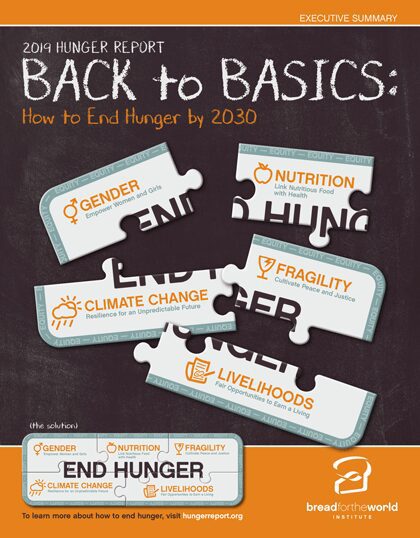
2019 Hunger Report Executive Summary
Ending hunger is within reach. 2030 sounds audacious. But decades of victory over hunger, despite recent setbacks, reveal a different picture. It is rapid global progress, not any one which persuades us that ending hunger and malnutrition is possible sooner rather than later.
Christian Study Guide
The study guide offers a biblically-based tool to explore God’s call to protect vulnerable people in the 21st century. The guide summarizes the report’s overall themes and provides discussion questions and group activities on select topics in the report.
Introduction: Ending Hunger is Within Reach
A national effort to end hunger could bring our country together and this goal has in fact, already brought the world together. Ending hunger and all forms of malnutrition by 2030 is one of the Sustainable Development Goals (SDGs) adopted in 2015 by the governments of 193 countries, including the United States, with support from their civil society and business sectors.
Chapter 1: Livelihoods
The only way to end hunger with dignity is to enable people to earn the income they need to provide enough healthy food for themselves and their children.
Chapter 2: Nutrition
Maternal and child nutrition is a critical factor in healthy human development. Nutrition is a lifelong necessity for the health and well-being of individuals, their communities, and ultimately their countries.
Chapter 3: Gender
Women in every society are treated as less valuable and/or less capable. Women and girls are the largest group of marginalized people. Yet food security is dependent on them.
Chapter 4: Climate Change
Populations that are most affected by the impact of climate change are those most likely to be hungry. Climate change is the biggest barrier to ending hunger once and for all.
Chapter 5: Fragility
When marginalized groups or people living in extreme poverty turn to violence, hunger is very often an underlying factor. Hunger is both a cause and an effect of the violence associated with fragile environments.
Religious Leaders’ Statement
“As followers of Christ, we believe it is possible to build the moral and political will to end hunger by 2030. The world has made unprecedented progress against hunger, poverty, and disease in recent decades. The United States has made progress more slowly than many other countries, but it is feasible to end hunger here, too.” — excerpt from religious leaders’ statement
Hunger Report Sponsors
Co-Publisher: Margaret Wallhagen and Bill Strawbridge; Partners: American Baptist Churches USA World Relief, American Baptist Home Mission Societies, Christian Church (Disciples of Christ), Christian Methodist Episcopal Church, Christian Women Connection, Church of the Brethren, Community of Christ, Cooperative Baptist Fellowship, Covenant World Relief/Evangelical Covenant Church, Evangelical Covenant Church, Evangelical Lutheran Church in America, Growing Hope Globally, Independent Presbyterian Church Foundation, International Orthodox Christian Charities, National Baptist Convention, USA, INC, Society of African Missions, United Church of Christ, Women’s Missionary Society of the African Methodist Episcopal Church
Related Resources
How Humanitarian Assistance Saves Lives
When global catastrophes strike, whether through conflict, natural disasters, or disease, communities find themselves without the most basic...

WORKING TOGETHER TO END HUNGER: 2025 Legislative and Policy Achievements
A series of administrative and congressional actions this year dealt devastating blows to the United States’ international assistance...